
2026-09-02 · Dennis O'Connor
Checking For Tree-Related Roof Leaks In Wooded Areas Of Waterford Works
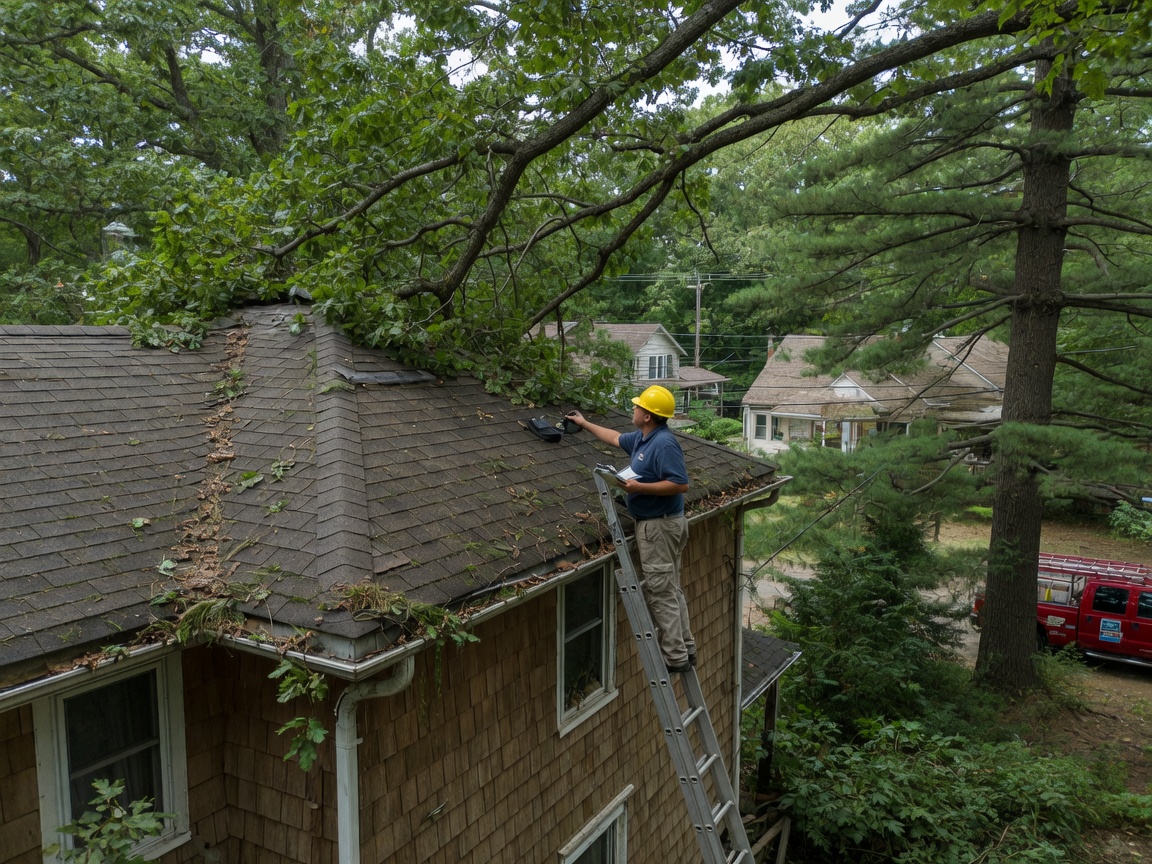
Waterford Works residents in Camden County can detect most tree-related roof problems from the ground and from inside the attic — by looking at which branches overhang the roof, watching what collects in the gutters, and checking for water stains in the attic after heavy rain or an ice event. The local climate works against you in both directions: hot, humid summers drive fast tree growth toward the house, and winter ice loads snap the limbs that growth produced.
Signs of tree damage in wooded neighborhoods
In the wooded sections around Waterford Works, mature oaks and pines drop limbs onto asphalt roofs during summer storms and winter freezes. From the ground with binoculars, look for cracked or displaced shingles directly beneath large overhanging branches, moss and algae growth on slopes that tree shade keeps damp, and scuffed or bare patches where a limb has been rubbing the surface in wind. That rubbing is the underrated one — a branch that touches the roof in a breeze will sand the granules off a shingle over a couple of seasons and expose the asphalt underneath.
Worth keeping in perspective: tree contact is one cause of leaks, not the usual one. Most roof leaks trace to failed flashing at a chimney or sidewall, a split pipe boot, or a worn-out roof. If you have a stain on a ceiling, the tree overhead is a suspect, not a conclusion.
Seasonal checks
Look twice a year and after any significant storm. Late spring clears the picture after winter damage, and early fall lets you deal with overhanging limbs before the leaves drop and the ice arrives. Leaf and needle debris collecting in valleys and around chimneys is the thing to watch — it holds moisture against the roof surface for weeks and rots the shingles and decking underneath from the top down.
Inside, check the attic for daylight showing through the deck, damp or matted insulation, and dark staining along the rafters. Interior signs frequently appear well before anything is visible from outside.
How to check safely
Stay on the ground. Almost everything described here can be seen with a decent pair of binoculars from the lawn, and the rest can be seen from inside the attic with a flashlight. Do not put a ladder up to get a closer look at the roof, and do not walk on it. Falls from ladders and roofs are one of the most common serious home injuries in the country, storm-damaged roofs hide soft decking that gives way underfoot, and a wet or mossy slope offers no grip at all. Nothing you might find up there changes what happens next — it still ends with a roofer on the roof.
From the ground, photograph the roof and the trees around it, including a wide shot that shows how close the limbs sit to the roofline. Those photos are genuinely useful later, both for a contractor and for an insurance claim if a limb comes down.
For the trees themselves, an arborist rather than a roofer is the right call. Cutting back limbs that overhang a roof is worth doing — it is far cheaper than a roof section — but large limbs near a house or anywhere near a service line are not a homeowner job.
The moss problem on shaded slopes
On wooded lots the north-facing slopes rarely dry out, and moss takes hold. Moss is not just cosmetic: it roots under the bottom edge of a shingle and lifts it, which breaks the water seal and holds moisture against the deck. It is treatable without replacing the roof — soft-wash cleaning at low pressure, never a pressure washer, which strips the protective granules and voids most shingle warranties.
When to bring someone in
Persistent interior staining, widespread granule loss under tree contact zones, or any visible puncture warrants a look from a roofer. Localized damage from a limb strike can usually be repaired without replacing the roof, which is worth knowing before anyone quotes you a full replacement. See roof leak repair for how leaks are traced, and how to spot roof damage after a nor'easter in Waterford Works for storm-specific signs that often overlap with tree damage.
McManus Roofing LLC answers calls 24 hours a day, 365 days a year — so if a limb comes through the deck at midnight, that is a call you can make straight away. Coming out to look at a roof and quote repair work is free.