
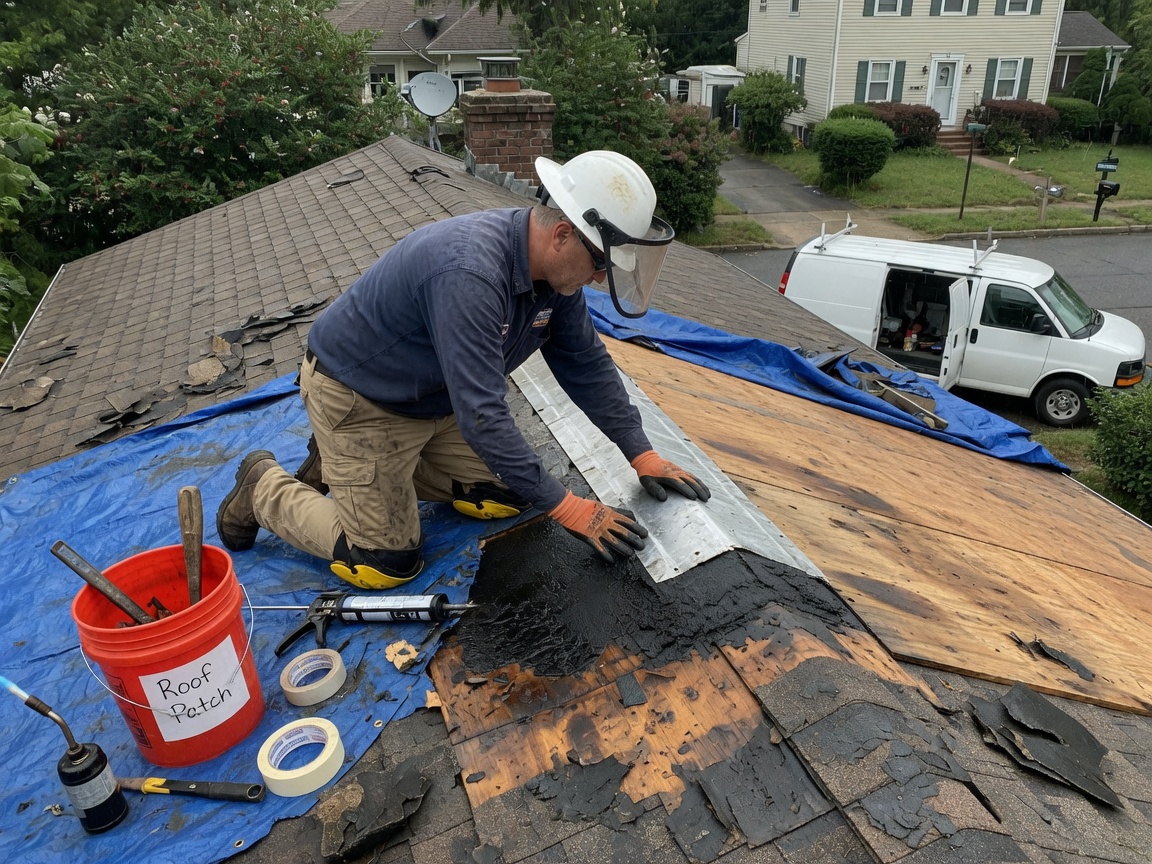
If water is coming in right now, call — whatever time it is. We answer the phone 24 hours a day, 365 days a year, nights, weekends and holidays included, and we mean it literally: we have taken leak calls at two in the morning on a Sunday and gone out the same night. Most of the damage a roof leak does happens in the hours when nobody is dealing with it. Eight hours of unattended water turns a flashing repair into drywall, insulation and paint. Getting a tarp on it tonight is almost always the cheapest thing that will happen to your roof this year.
Waterford Works sits in Camden County where many homes built between the 1950s and 1980s still carry original asphalt shingles over plywood decks. Hot humid summers drive repeated expansion and contraction while cold winters bring ice dams along north-facing eaves, pushing water under shingles and into attics. We trace leaks by lifting specific courses rather than tearing whole sections, then replace damaged underlayment and step flashing before the next freeze-thaw cycle can widen the problem.
We find the entry point, not the stain. This is the part that decides whether a repair holds. Water lands on the deck and runs along a rafter — frequently several feet, sometimes across the width of a room — before it finds a seam in the ceiling and drops through. Repairing directly above the stain is the single most common reason a leak comes back, and it is why people end up paying three roofers for the same problem. We get into the attic where access allows and follow the water back uphill to where it is actually entering.
Common leak points here include the valleys where two roof planes meet and the step flashing around chimneys, which on the local ranches and split-levels is often the original galvanised metal. We run ice-and-water membrane at least six feet up from the eave and six inches past the valley centre line, because that is where the water actually goes after a nor'easter. Homeowners often discover the leak only once ceiling drywall stains appear, so we always check the insulation for hidden moisture before closing the roof back up.
When a leak originates near a bathroom vent or skylight, we remove the old boot or curb flashing entirely instead of layering new material over failed sealant. Sealing over a failed detail only buys a little time; replacing the detail puts the roof back to how it should have been built. Every repair includes a full ridge-to-eave inspection so we catch adjacent weakened nails or cracked ridge cap before they become the next call.
Emergency first, permanent second. On an active leak the order matters. We tarp and stabilize so the interior stops taking water, then schedule the permanent repair for when the roof is dry enough for the work to actually hold — a repair laid into a wet deck in poor weather will fail. If the roof turns out to be past repairing, we will tell you that and quote a replacement rather than selling you a patch on a finished roof.
Technician insight
In Waterford Works the thing that catches most people out with roof leak repair is the ice dam that forms right at the gutter line on 1960s ranches; homeowners think the leak is a bad shingle but the real path is under the first course because the original felt has dried out after decades of Camden County freeze-thaw cycles.
What An Ice Dam Leak Usually Looks Like
A typical January call: a stain spreading on a bedroom ceiling a few days after snow, on the side of the house that gets least sun. The dam at the gutter line has held meltwater back until it worked under the first few courses, where the original felt has long since dried out and split. The work is lifting those courses, running ice-and-water membrane up from the eave, sorting out any step flashing at the chimney that has come loose, and relaying shingles over the top. Attic ventilation gets a look at the same time, since the heat coming up from the house is what makes the dam.
Roof Leak Repair Services We Offer
✓24/7 Emergency Leak Response
Phone answered at any hour of any day. We tarp and stabilize to stop active water intrusion, then schedule the permanent repair once the roof is dry enough for it to hold.
✓Leak Tracing and Diagnosis
Attic and roof inspection to follow water back to its actual entry point, which is frequently several feet uphill from where the ceiling stain appears.
✓Asphalt Shingle Leak Repairs
We replace individual damaged shingles and the underlying felt or synthetic underlayment on Waterford Works homes without disturbing sound sections of the roof.
✓Flashing Replacement
Step flashing, counter flashing, and valley metal are removed and reinstalled with new ice-and-water membrane to stop water intrusion around chimneys and dormers common on Camden County ranches and split-levels.
✓Ice Dam Leak Repairs
After winter storms we clear ice dams with steam, install extended ice-and-water shield, and improve attic ventilation to prevent recurring leaks in older Waterford Works attics.
✓Skylight and Vent Boot Repairs
We replace cracked skylight curbs and deteriorated rubber vent boots that fail under Camden County UV and temperature swings, restoring a watertight seal.
✓Gutter and Downspout Leak Fixes
Leaking gutters and misdirected downspouts are repaired or re-pitched so water no longer backs up under the first course of shingles on Waterford Works properties.
Roof Leak Repair Cost in Waterford Works, NJ
| Service | Typical Range | What Affects It |
|---|---|---|
| Single shingle and underlayment repair | $250–$550 | Price rises with roof pitch and second-story access. |
| Valley flashing and membrane replacement | $300–$650 | Depends on length and whether both sides of the valley are affected. |
| Chimney step flashing repair | $300–$650 | Includes new counter flashing; higher on two-story homes. |
| Skylight curb and boot replacement | $225–$450 | Varies by skylight size and whether curb needs rebuilding. |
Ranges are typical for Waterford Works, NJ and confirmed with an exact written quote before any work starts.
How it works
- 1
Call Us — Any Hour
The phone is answered 24 hours a day, 365 days a year. Tell us what you are seeing and where, and whether water is actively coming in.
- 2
Emergency Tarp and Stabilize
On an active leak we get the roof covered first so the interior stops taking water, before anything else is discussed.
- 3
On-Site Leak Assessment
We inspect from the attic and roof and follow the water back to its real entry point, marking every active and potential leak.
- 4
Targeted Tear-Off
Only the affected courses and flashing are removed so the rest of the roof remains undisturbed.
- 5
Underlayment and Flashing Upgrade
New ice-and-water membrane and properly lapped flashing are installed at valleys, eaves, and penetrations.
- 6
Shingle Replacement and Final Check
Matching shingles are reinstalled and the entire repair area is water-tested before we leave.
Pricing
These are estimated ranges for planning only — every roof differs on pitch, height, access and what we find once the shingles come up. The exact price comes from a free on-site visit and a written itemized quote. Call us and we will come out.