
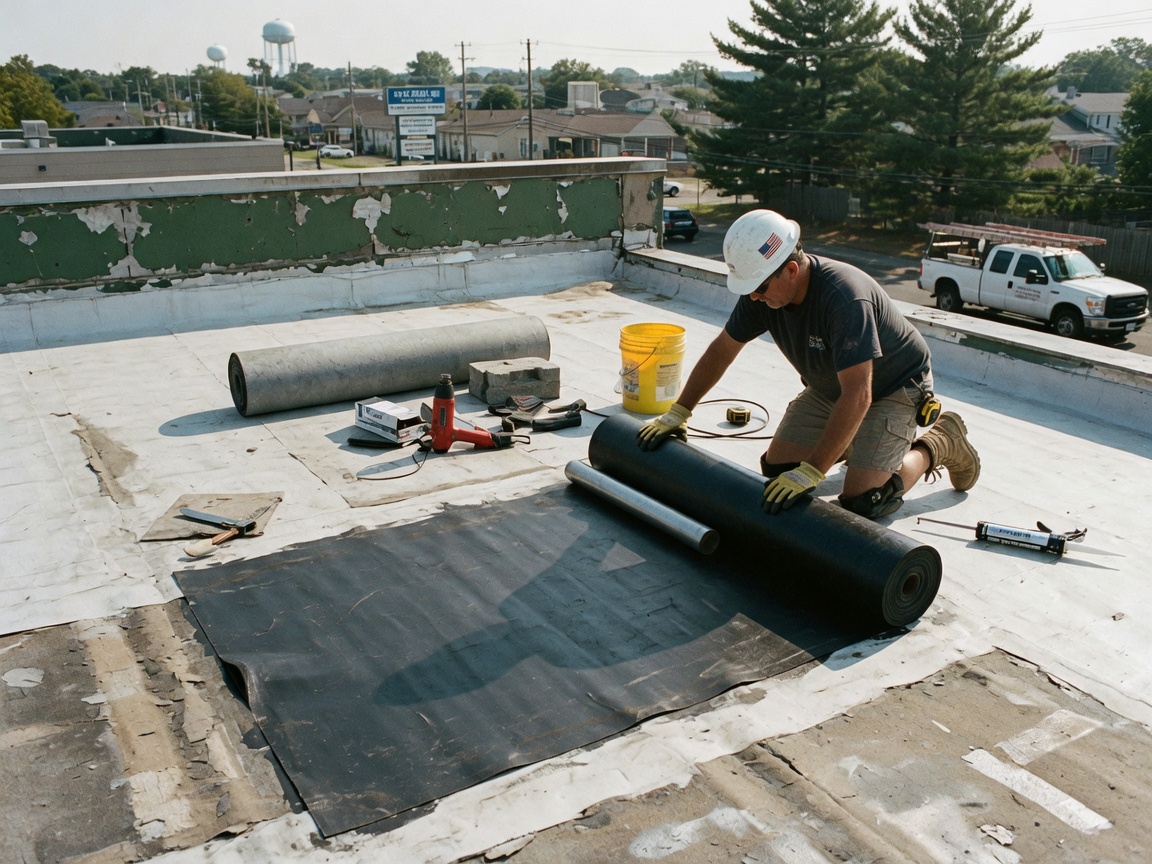
Rubber roofing, typically EPDM membrane, suits the humid subtropical climate in Waterford Works where summer heat expands materials and winter freezes contract them. It is the right material for genuinely flat and low-slope areas: rear additions, porch and sunroom roofs, detached and attached garages, and the flat tops of dormers and bay windows. The main house roof on a local ranch or split-level is normally pitched and takes shingles — it is the flat sections tacked on later that need a membrane. Proper seam sealing and adhesive or ballast attachment prevent leaks that start at flashing points against walls and chimneys, and edge details have to account for wind-driven rain pushing under loose perimeter metal during storms coming up the Delaware Valley.
EPDM is not the only flat roof system, and it is not always the right one. We also install and repair modified bitumen and built-up roofing, and which one belongs on your roof depends on traffic, slope and what is already there. Modified bitumen is an asphalt-based membrane reinforced with polyester or fibreglass, laid in two plies — a base sheet and a granulated cap sheet. It is noticeably tougher underfoot than single-ply EPDM, which makes it the better answer on any flat roof that gets walked on for HVAC units, satellite dishes or window access. It can be installed self-adhering or in cold adhesive; we generally avoid torch application on residential work, because an open flame against old wood framing and knee walls is a fire risk that is not worth taking when cold-applied systems perform just as well. Built-up roofing — the traditional tar-and-gravel assembly of multiple felt plies in hot asphalt with a gravel surface — is what you will find on a lot of older commercial buildings and some 1950s to 70s flat residential sections around here. It is heavy and extremely durable, and on a sound BUR roof the right work is usually re-flashing, patching and re-surfacing rather than a full tear-off.
Installation begins with a deck inspection. Rot is common on flat sections built in the 1970s to 1990s, and on a flat roof it is usually moisture trapped inside the assembly rather than anything to do with a vented attic — an old membrane that has been leaking quietly for years, saturated insulation above the deck, or a shed roof tied into a wall with no proper counterflashing. We remove existing gravel or old membrane, then apply new 60-mil EPDM with seam tape rated for temperature cycling between 95-degree summer days and 20-degree winter nights. Tapered insulation boards correct ponding areas. Penetrations for vents and skylights receive pre-molded boots to avoid the cracks that develop when standard caulk fails after repeated freeze-thaw cycles.
Repairs focus on storm damage and seam splits that appear after cold snaps, using matching EPDM patches bonded with compatible adhesive rather than generic sealants. Where a membrane has been leaking for some time we check the deck and the insulation above it for trapped moisture, because patching over a wet layer does not last. Full replacements include new edge metal and drainage improvements — re-pitching to the outlet, a second outlet where one is not coping, and gutter and downspout corrections — to handle the intense summer downpours.
Flat roofs reward scheduled upkeep more than any other kind. A pitched roof sheds water whatever happens. A flat roof holds it, so a blocked outlet or a lifting seam escalates from minor to structural far faster. If you own a flat or low-slope roof, a roof maintenance plan covering drains, seams and terminations is close to the cheapest insurance available — and on commercial buildings we schedule it around your operating day. For an active leak, the phone is answered 24 hours a day, 365 days a year.
Technician insight
In Waterford Works the thing that catches most people out with rubber roofing is how quickly seams split after a hard freeze when the original installer used the wrong adhesive for our winter lows. The other one is flat porch and addition roofs where the membrane has been weeping at a wall for years — by the time a stain shows on the ceiling below, the insulation above the deck is often soaked and the sheathing has gone soft.
What A Seam Failure Usually Looks Like
The common winter pattern on a flat addition or porch roof: a stain appears on the ceiling below after a hard freeze, and up on the roof a seam has pulled where the original tape could not cope with the membrane contracting in the cold. The work is cutting back to sound material, checking whether the insulation and deck underneath have taken on water, taping in a new patch with adhesive rated for our winter lows, and tidying up the perimeter metal so the edge is held down properly.
Rubber Roofing Services We Offer
✓EPDM Membrane Installation
Full rubber roof replacement using 60-mil EPDM sheets adhered or ballasted on flat and low-slope areas: additions, porches, garages and dormer tops.
✓Modified Bitumen Roofing
Two-ply asphalt membrane with a granulated cap sheet, installed self-adhering or in cold adhesive. The better choice on flat roofs that take foot traffic for HVAC or window access.
✓Built-Up Roofing (BUR)
Repair, re-flashing and re-surfacing of traditional tar-and-gravel built-up roofs, common on older commercial buildings and mid-century flat residential sections.
✓Rubber Roof Seam Repair
Targeted fixes for failed tape or adhesive seams that leak during winter freeze-thaw cycles in Camden County.
✓Flashing and Edge Detail Work
Replacement of perimeter metal, wall counterflashing and pipe boots to stop wind-driven rain intrusion on flat roofs.
✓Ponding Water Correction
Tapered insulation and drainage upgrades that eliminate standing water after summer storms in Waterford Works.
✓Urgent Rubber Roof Patch
Temporary and permanent patches for active leaks during heavy Camden County rainfall. The phone is answered 24 hours a day, 365 days a year, and we can usually get out quickly.
Rubber Roofing Cost in Waterford Works, NJ
| Service | Typical Range | What Affects It |
|---|---|---|
| Full EPDM replacement | $4.50–$7.50 per sq ft | Includes membrane and basic flashing; deck repairs add cost |
| Modified bitumen replacement | $5.50–$8.50 per sq ft | Two-ply system; better suited to roofs that take foot traffic |
| Seam or patch repair | $250–$550 | Varies by number of locations and access difficulty |
| Flashing replacement | $300–$650 | Perimeter, wall or penetration work on older homes |
| Ponding correction | $800–$2,200 | Tapered insulation and new drains |
Ranges are typical for Waterford Works, NJ and confirmed with an exact written quote before any work starts.
How it works
- 1
Site Assessment
We inspect the existing membrane, deck condition, and drainage on your Waterford Works roof during daylight hours.
- 2
System Selection
Choose between EPDM, modified bitumen and built-up repair based on slope, foot traffic, wind exposure and what is already on the deck.
- 3
Deck Preparation
Remove old material, repair rotted sheathing, replace any saturated insulation, and install tapered boards where ponding occurs.
- 4
Membrane Application
Roll out and adhere or ballast the new membrane, sealing all seams and penetrations with temperature-rated products.
- 5
Final Inspection
Check seams, edges, and drainage before leaving the site, then schedule follow-up after first heavy rain.
Pricing
These are estimated ranges for planning only — every roof differs on size, access and what we find under the old membrane. Note the EPDM replacement figure is per square foot rather than a whole-roof total. Modified bitumen generally runs slightly above EPDM per square foot. Call us and we will come out and give you an exact written figure — the visit and the quote are free.